Showing posts with label China. Show all posts

Tuesday, April 21, 2009

The Future of 900 Million Farmers

The United States has one quarter of the world GDP, and China has one quarter of the world population. It says it all about the Chinese economy. Of the one quarter world population or almost 1.4 billion strong in China, 900 million are farmers.

You would have guessed that such a large population would impose tremendous pressure on the food supply. I did some googling and find that China has done quite well on food production.

China, a Big Farm by Figures

image

China has a smaller share of land and arable land compared to the size of the population.

image

The population density is one of the highest.

image

But over years China has established an ample self-supply of cereals (rice, wheat, maize, etc.), and has dramatically increased the production share of meat, fruit, vegetables and fish..

image

..with a trade surplus.

image

The food gap is closing and people are eating more everyday. I assume the obesity kid summer camps would soon be overcrowded.

10% More for Food Safety

Now the government now has a not-so-ambitious new plan to hike food production by 10% till 2020. The plan plans to maintain the arable land area at 1.8 billion acres, a part that Mr. Mao, a renowned economist, doesn’t quite agree.

I don’t know too much about farming, so my comment probably wouldn’t help. But I found the public sentiment against Mao disturbingly amusing – if property rights per se is a mass, what’s (or whose) there to argue about?

Anyhoo, there’s plenty of opportunities to improve farming yield comparing to Monsanto America and Syngenta Germany, holding all other variables constant.

image

Poor Farmers, Rich Farmers

Food safety, local and global, seems not an adjacent problem into 2030. The real issue is how to improve the poor farmers’ income.

  • In 2005, 949 million live in villages, of which 299 million (23% pop) are farmers.
  • Urban income per capita is RMB 15,781 in 2008, while that of villages is RMB 4,761, or 30% of urban.
  • GDP of agriculture, forestry, fishing and hunting, or the so-called Primary Industry, was 11% of total in 2007.

You do the math.

As a comparison, in the U.S. 1.4 million (0.5% pop) works in agriculture, forestry, fishing and hunting – one person per one big farm, farming with GPS guided John Deeres. The GDP share is 1.2%.

Yes, you can get rich being a farmer.

How to Get There? The short answer is it takes time, the long answer ..

http://icecurtain.blogspot.com/

Thursday, April 16, 2009

The Paradox of a Money Printer

This is a preliminary note on the very unique Chinese banking system, with a focus on the monetary operations.

The Chinese Banking System

China doesn’t have a well developed and sophisticated capital market and financial system. No pains, no gains.

Though constantly evolving, the perception is that Chinese banks are more of the old-day bank-at-the-street-corner type. They take deposits and make loans or buy government bonds. No securitizations, no excess derivatives.

The total assets of the financial sector is of RMB 50 trillion in size (1.7x GDP), over 90% funded by deposits. Market shares are concentrated. The big four – ICBC, ABC, BOC and CCB – controls over half of the assets, and the major shareholder of those four is the Chinese government.

Yes, the banking system is nationalized, in good times and bad, and it works in its own way. No free market, supply and demand mechanism for interest-bearing loans and securities: the central bank, PBoC, sets the entire ladder of interest rate, from that of deposits to loans.

Sounds like a boring, stable, socialist banking system, right? Oh, except the astonishing rate of non-performing loans (NPLs).

image

It was about 20% at its peak, though the situation is improving in recently years. At such a level, banks are easily bankrupt despite of hefty fee collection due to lack of competitions. An example here. I don’t know how they did that – it’s not easy. One possible explanation is that it’s policy-driven. More on this later.

But the good news is that banks are nationalized, so that the government is there for bail-outs, in good times and bad. No FDIC type of deposit insurance necessary.

PBoC’s Ever-expanding Balance Sheet, Reserve Ratio and Sterilization

Monetary policy is a completely different craft in China. Take a look at PBoC’s balance sheet and you would know why.

image

What drove the rapid balance sheet expansion is China’s foreign reserve accumulation, topping $2 trillion today. Besides causing trade tensions, safety concerns and controversies, the current account surplus pile-up is rather a headache for PBoC: it floods China with money and threats with inflation.

How is PBoC fighting against it? They do two things – reserve ratio escalation and sterilization.

image

The above is the deposit reserve ratio (a portion of banks’ deposit money kept with the central bank to control the upper limit of credit). It is climbing up, until later last year.

The other one is the bond issuance by PBoC to sterilize money supply, or to take money out of the marketplace. It totaled over RMB 4 trillion – not a negligible amount and it would keep ascending as long as there is CA surplus.

There’s another possible way – to spend it. It is an incredible amount of money to spend. I did some long posts on it.

An Example: Stimulus Package in Chinese Way

Remember China’s RMB 4 trillion stimulus package? (Admittedly, I didn’t do the homework well.) It’s a perfect demonstration of how powerful the system is.

image

Amazingly, it seems happened overnight, and no known complaints.

It is still developing and the result is yet to be seen. I might well be wrong.

Will PBoC be Insolvent?

Sounds like a crazy question, since it prints money (not exactly) freely. But it doesn’t hurt to contemplate either.

One issue is the exchange rate. I don’t know how exactly they do the book-keeping on the foreign assets (mainly foreign reserves, plus some gold and others), but notice that RMB has been appreciating. If marked to market, the decreasing value of the foreign assets would drag the net worth underwater. Funny, since PBoC sets exchange rate and they are doing so to bankrupt itself. If there’s an outflow, it would be cash-based.

Another issue is interest rates that determines the income statement. PBoC collects interest payment mainly from foreign assets and pays out on deposit reserve and bonds. If (well-controlled) domestic interest rate is higher than foreign, it eats into the capital. As you can see, not much is left.

It’s not risk free, after second thought.

Does it matter and what to do?

http://icecurtain.blogspot.com/

Monday, April 13, 2009

Bear Rally?

Did I once mentioned that stock markets work the same way as inflation does – meaning higher demand would drive up price?

image

The above is the new accounts opened weekly for Shanghai Stock Exchange A-shares.

image

If you compared to the index, they are almost of the same shape.

image

The above is mutual fund flow data.

image

You may have guessed it.

I see few reasons for euphoria, but you should consider stock market for now – stay near the door though.

http://icecurtain.blogspot.com/

Sunday, April 12, 2009

Home Appliances for Villages

Chinese economy needs a structural change, and many seem to agree that to stimulate domestic demand is key.

In my view it is something rather fundamental, but short-cut ideas fly around. Look at this guy, who is a people’s representative of the National Congress, advocate a nutty idea of national holiday to release domestic demand. By that logic, unemployment would really help.

BTW, the guy owns a tourism company, so that more leisure time would surely boost his business, and he spoke bluntly about it. Great. While convening to speak for the people, why not as well use the marketing platform to speak for himself?

Recently an usual thing happened – the government decided to subsidize farmers to make home appliance purchases by reimbursing 13% of sales price. Items include TV, cell phone and fridges.

It’s a serious project. They even built an online information management system for it. According to one village survey, farmers are satisfied, though not without concerns.

It is somewhat another unprecedented, well-intentioned socialism move by the government.

Leave the gun, take the cannoli.

http://icecurtain.blogspot.com/

Friday, April 10, 2009

Chinese Consumers’ High Saving Rate

There is a cute little household wealth survey by Statistics Bureau in 2002, which helps explain the high saving ratio of Chinese consumers.

“[..]子女教育、养老、防病成为居民家庭进行储蓄的主要目的。在调查问卷列示的十余种储蓄目的当中,把子女教育摆在首位的家庭最多,达到36.5%。而实现子女教育消费则周期较长;排在第二位的储蓄目的是养老,选择率为31.5%,我国目前已步入老龄化社会,但由于社会保障制度尚不完善,不少被访者特别是中老年被访者对未来养老问题表示担忧,故以此为首要储蓄目的的家庭也超过了三成;排在养老之后的储蓄目的是防病,选择率为10.1%,在医疗制度改革后,由个人承担的医药费比例明显提高,居民家庭用于治疗和药品方面的支出大幅增长,因此以防病作为首要储蓄目的的城市家庭逐渐增多。除子女教育、养老及防病外,选择率靠前的储蓄目的还有买住房(7.2%)、子女婚嫁(5.7%)和防失业(3.0%)。”

I have an earlier attempt to tackle here.

If you look at the household financial assets of Japan, another Asian high-saving rate country, the household balance sheet looks almost the same, though of different magnitude and for different reasons.

The United States is a completely different case. Take a mortgage, take a dozen of credit card, and cross over what’s on the shopping list or not, then pay down overtime, or never.

It is not a contemporary phenomenon driven by sophisticated financial engineering, but started a century ago.

http://icecurtain.blogspot.com/

Almost Universal Healthcare: Can We Afford it?

This post in a response to China’s new Healthcare Reform Plan.

I don’t have to repeat the importance of healthcare. Now, finally we take the courage to work towards one. Hoorah!

Key Features of the Healthcare Reform

The health reform plan spans into 2011, budgeting an additional RMB 850 billion or 1% GDP annually, with a bit over 1/3 from the federal government.

It aims to cover 90% with healthcare insurance – a comprehensive landscape change from the mere 15% coverage as of today.

It establishes a nationwide procurement and distribution system on a list of basic drugs. The government would reign in drug prices, and public healthcare providers would retail drugs at purchase cost.

It would separate drug prescription and purchase – a break from the current hospital-also-sell-drugs system, presumably to avoid conflict of interest.

It will build a lot of new hospitals, with the goal to cover each and every village in the country.

It would provide training to 2 million healthcare personnel.

..and many, many other good stuff.

Overall, it is a tremendously exciting one and a courageous move of the government. Send in your thank-you note.

China Health, an International Comparison

If you have time, read WHO’s ultimate death book for a global health overview. Here’s a screenshot.

image 

China, still a poor developing country, lags behind the developed in many aspects on healthcare.

image

The life expectancy is on average 7-8 years shorter in China than G7 countries. Want to live longer? Move to a developed country.

image

The infant mortality rate is much higher.

image

image

Infectious and parasitic diseases, perinatal conditions, and injuries caused much more death per person.

China’s Premature Healthcare Infrastructure

image

image

Healthcare service coverage is primary compared to G7.

image

image

And environmental infrastructure lacks.

The Disparity of Healthcare Expenditure

image

Even on PPP-based, China spends per capita 7.5% of the average of G7’s. Not 75%, but 7.5% - No kidding. Did somebody call China a threatening super-power?

GDP-wise, China spends 4.5%, while G7 countries spends about 8-10%. The exception is the U.S., who expends a 15% from an already forerunning GDP, without seeing obviously better health conditions other than occasional personal bankruptcy of the 16% uncovered (hearsay: most other developed countries have universal healthcare). Mystery.

image

China doesn’t have an established health insurance system, with over half health expenditures paid out of pocket. It is almost eye-popping that there would be a 90% coverage.

A Concern on Cost

It is a common knowledge that national healthcare cost usually overshoots, and sometimes explodes. So we have to worry about it, though it may not be a good time.

There are several “detonators.” One is aging.

image

The Chinese population is relatively young, but it is turning old.

image

Age drives up healthcare expenditure exponentially.

image

Another factor worth attention is healthcare price inflation. For example:

image

The situation of China doesn’t look good at all. Despite that unit cost increase may not be the only factor, the per capita inpatient and outpatient expenditure per treatment paced up much quicker than consumer price index.

image

Can We Afford it?

With many fickle economic, social and natural variables, it is near impossible to predict the future cost of a national healthcare system. I hate to be a fortune teller here.

The key question is: do you see healthcare a cost or a contribution to the economy?

http://icecurtain.blogspot.com/

Monday, April 6, 2009

How the Money is Spent?

Do an intellectually lazy post on a short- to medium-term outlook of Chinese economy.

  • There’s a credit expansion in Q1, with a targeted increase of RMB5 trillion from ‘08
  • There’s a 20% YoY drop of export (an increasingly significant part) in Jan and Feb, reversed from 20% increase in ‘08
  • Corporate profit is hurting, almost 40% YoY dip in the first two months for large-size industrial companies

Hmmmm, so we are taking more debt while selling less and earning less. Not a good sign, is it?

http://icecurtain.blogspot.com/

SASAC, the Big Boat that Tugs and be Tugged

There is a news piece about the Chinese SOEs (state-owned enterprises). If you are not familiar with how the Chinese system operates, it would be quite inspiring.

MoF as an Activist Investor: What A News Piece Reviews

The news is about the negotiation between the SOEs and SASAC (State-owned Assets Supervision and Administration Commission of the State Council, a long name that you should remember). SASAC is a government agency that manages the SOEs worth $1 trillion -$4 trillion, including major resource-based, government-monopolized Fortune 500 companies.

The story goes that because of diminishing profit in ‘08 ($100 billion or 30% below ‘07 level, after 30% increase in ‘07), SOEs are pleading for a deduction in budgeted profit turn-in, but SASAC is not relenting, stating that the money is of crucial use, for things like capital investment in strategically important SOEs and capital replenish for the weakened state-owned utilities and airlines. MoF weighed in to support SASAC’s view.

I have thought that Chinese companies hold too much cash, and paying out extra cash to relocate the capital may be a good idea, despite of the less efficient capital market. (As a reference point, share buyback have been a popular move for S&P 500 corporations in recent years.) Since the CEOs are increasingly richer and more powerful, most individual investors could only act as dividend takers.

It is a completely different case when the government steps in. It must be a tough act for the SOEs.

The Long Value Chain

What’s more interesting is the nexus of money of the colossal Chinese SOE system. I’ve raised the issue when looking at China Shenhua, a partially-listed, state-owned coal and utility company.

Let me belabor the point with yet another example – PetroChina.

  • PetroChina, Limited is a public oil & gas company listed on Shanghai Stock Exchange, Hongkong Stock Exchange, and ADR-ed on NYSE, with ‘08 sales of RMB1 trillion and book assets of RMB1 trillion.
  • The above is 87%-ly owned by PetroChina Corporation, who is not a mere holding company but one with a much larger size, with ‘08 sales of RMB9 trillion and book assets of RMB14 trillion. It is ranked #38 of Fortune 500.
  • The above is a SOE managed by SASAC, thus 100% owned and managed by the Chinese government.

How the government runs the SOEs such as PetroChina? You may ask. The answer is quite complicated, but here’s a quite telling executive order. The order mandates that SOEs shall do a separate book-keeping with the government, with items including budgeted profit turn-in, capital gains from selling state-owned shares (which is another complicated matter that drives the vicissitude of the Chinese stock market), etc.

In return, I assume that the government would (have to) ensure the overall profitability, in one way or another. What’s socialism is about otherwise?

Should you Invest with China, Inc.? Individual Investors’ Perspective

If you are an individual investor asking for stock advices on PetroChina and its ilk, I don’t know what to tell you – I am not prepared for this. The success very much depends on how well you read the multi-trillion China, Inc. and how it works. In other words, besides reading the 10Ks of the listed companies that is only a tip of the iceberg, you should read the much bigger (somewhat opaque) book behind.

The good news is that instead of an invisible hand, the hand is visible. The bad news is that it is quite unpredictable: imagine to tell the fortune of a child with powerful parents, who would presumably take care of his interest. But it is a big family and parents are busy with a range of considerations. That child - though spoiled a bit - may not be the preferred from time to time.

Friday, March 27, 2009

An Argument Against the International Reserve Currency Proposal

Mr. Zhou Xiaochuan, Chairman of Monetary Policy Committee of the People's Bank of China (PBoC), has created quite some buzz with his proposal to Reform the International Monetary System. I expressed my surprise earlier here, and clearly I misunderstood it at first. After rereading his proposal carefully, I don’t think it is very much constructive.

Now Mr. Zhou is widely recognized as an achieved monetarist, with an extended knowledge and unparallel insights of international and domestic economic and monetary matters - I have admittedly learned a great deal studying his influential speeches.

On this specific issue, however, I would have to express a somewhat different opinion.

The Proposal

I don’t need to repeat the well known and escalating global imbalance – tons of literatures are available online. Mr. Zhou’s proposal is to expand the role of IMF’s Special Drawing Rights (SDRs) as the international reserve for transaction clearance among nations, replacing the prevailing USD.  A full page of SDR description here.

To summarize it, IMF allocate SDRs to nations on a specific quota. The initial quota is here (it reads like a will, with the U.S. being the favorite son) and the change of it requires “[a]n eighty-five percent majority of the total voting power.” The value and interest rate is equivalent to that a basket of major currencies - today consisting of the euro, Japanese yen, pound sterling, and U.S. dollar.

Why SDR Won’t Solve the Problem

SDR is a type of money. Though not the money that you can do shopping with, nevertheless it is money. The function of money is: a medium of exchange, a unit of account, and a store of value. Mr. Zhou’s worry comes from USD’s store of value, or inflation.

Is SDR inflation-proof? Think of it as a basket of currencies – expand to include all world currencies if you like – the shares proportional to trade volume (not that important actually), so that you can create synthetic SDR with that basket of currencies.

The value of SDR, or your basket of currencies, is measured by what you can buy on them. (Yes, value of goods are measured by money as well as the value of money is measured by goods. So wicked!) When some country for some reason prints a lot of money, it inflates and its currency depreciates. If the currency is in the basket, the purchase power of your basket depreciates as well.

If China exchanges a basket of USD for SDR, inflation remains a concern – except instead of distrusting the United States you have to distrust many countries’ monetary policies. I would argue that the United States appears a bit more reliable on this one – it takes much pressure (though increasingly possible) to inflate in the United States, a nation of whiners, on almost everything.

What To Do Then?

I honestly have no idea – told you that money is much a headache. It appears there is nowhere to run, except that China could manage RMB effectively, only without a large amount of foreign reserves as a byproduct of the export-driven growth strategy.

There are however several ideas to explore. One is the TIPS, though the Chinese reserve is oversized for it. Another one is holding assets correlated to inflations, and it introduces new source of risks. The U.S. treasury is risk free – check your corporate finance textbook if you have any doubt. Or should we maybe reconsider the Gold Standard? Historically it has been a source of problems.

Alas! Nowhere to run. Why is money necessary?

http://icecurtain.blogspot.com/

Thursday, March 26, 2009

What Should China Do with $2 Trillion? (Part 2)

This is the second part of the series. First part here.

The Alternatives

Holding $2 trillion dollars, the Chinese authority has several options.

A Portfolio of US Treasury managed by PBoC

This is the status quo. Don’t think it is risk free return. Besides risk of inflation as I mentioned earlier, there is also exchange rate risk and a hard decision of short/long term allocations.

While the yield curve is influenced by the Fed, the possible reallocation of the Chinese reserve would inevitably move the yield due to the size of the portfolio. Out of curiosity, I would like some transparency of the current arrangement, or will I be asking for too much?

A Sovereign Fund

This one has also been carried out. China Investment Corp (CIC), is managing $200 billion financed by debt issued by Ministry of Finance. Ostensibly the risk is transferred to another entity, actually if CIC goes under the government would be footing the bill.

Again, some transparency would help. At lease have some press releases, as does the Abu Dhabi Investment Authority (ADIA).

Financial Investment by Citizens

This is to offer global investment options to local citizens in China - saving rate is high. Instead of limited local personal financial options, offer choices of international equities, bonds, commodities, REITs, etc.

It may partially solve the problem of dollar flood, but it sounds a bit dangerous, doesn’t it? Besides, it seems out of line of the current Forex management philosophy of the government. The consumer protection regulations may not be ready as well.

M&A by Corporations

We live in a global village. A large and uncultivated local market notwithstanding, Chinese corporations have to be global in scale to contribute to the global economy. Foreign merge and acquisitions or FDI sounds a natural step.

I am talking about strategic acquisitions and/or investment (vs. financial ones for financial gains). With global asset price depressed, it is never a better time.

The Chinese companies’ global footsteps have been intensifying, mostly in the resource acquisition area. Google it for more information. But I would like to stress the obstacles here, without an intension to be negative.

First, there is a huge historical, social, political, legal, cultural, linguistic gap. China has been a closed economy for a long time, seriously lacking experiences of global operations. Besides, we are commies. Chinese companies grew up under a different sets of rules and competitive environment. There are a lot to learn.

I have to point out one misconception: Chinese pundits like to distinguish mature market (i.e., developed economies) vs. immature market (developing economies) and insist that the later is more suitable for Chinese companies. The not-so-conventional wisdom makes less sense to me. The so-called mature market is called so for a reason – open market of greater size, well established infrastructure, a more complete legal environment – overall, a safer investment field in spite of competitive intensity. Why giving up?

Secondly, worthwhile competitive advantages have to be established. Chinese companies are perceived as low-cost producers - China’s nominal GDP per capita is $18k, while most developed countries are above $40k. Or you can look here.

However, cost leadership is an edge easy lost. sustainable global businesses require the emergence of some serious global brands, based on technology advance, management and operational capabilities. There are but few established examples.

Thirdly, it needs a capital market for financing needs – few companies can afford the bills by operation cash flows alone. Chinese banking system are nationalized and theoretically inefficient on capital allocation, not mentioning lacking international exposures.

Finally, it returns to the topic of exchange regime. RMB is appreciating at 5% per year, raising the bar of required rate of return. 

http://icecurtain.blogspot.com/

Wednesday, March 25, 2009

Planet Earth Dollar, Really?

Zhou Xiaochuan, governor of the People's Bank of China, proposed the creation of a world currency, according to WSJ.

China called for the creation of a new currency to eventually replace the dollar as the world's standard, proposing a sweeping overhaul of global finance that reflects developing nations' growing unhappiness with the U.S. role in the world economy.

Really? Did he really my earlier paper? Has not the haves and have-nots of the Euro brought us enough fun?

I can think of at least two guys that would say no – the almighty British empire that’s for long coy on joining the Euro, and Zimbabwe whose president is busy printing money in .. sextillions (with an s?).

Monday, March 23, 2009

What Should China Do with $2 Trillion? (part 1)

Suppose you are a maize farmer. I buy some maize from you with some money. Just another day in life, right?

What if I tell you that the money I pay you is not your kind of money, but my money, which I can print as much as I want to? Would you hesitate to accept that money?

Furthermore, you cannot really use that money, and you have to deposit it at a bank. Guess who is the bank? It’s me, and I set the interest rate.

Would you still selling the maize to me? Few will. But that’s more or less what the US is doing to many nations, especially those in Asia. China accumulated $2 trillion by exchanging goods with the United States for paper money that the country printed.

In this article, I will show you all sides of the story behind it.

The Dollar and US/China Imbalance

Money flow among countries via trade (of goods and services) and investment (in financial or hard assets). If you pay more and receive less, you are running a current account deficit.

The problem is countries have their own money, and it has caused headache for hundred of years because of the exchange rate and its related bunch of troubles. The consensus today is that dollar is the major international currency, so that countries write checks to each other in dollar.

Why dollar, you may ask? Well, it used to be gold, and the one with dollar is kind of a long and unpleasant story. The gist is counties don’t trust each other too much when it comes to printing money, and the United States is relatively a reliable one (and more importantly a rich one). Some country like Ecuador even gave up its own currency and dollarized (meaning they use the US dollar as their official local currency) – must have a lot of fond memories. On the other side of the Atlantic Euro is becoming a regional currency, with advantages and disadvantages.

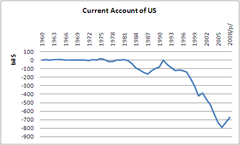
Anyway, the United States has been running a current account deficit in recent years (chart below). The ‘08 number is $673 billion, around 5% of GDP. Among them $306 billion is with China.
image

So that along the way China is piling up US dollars. It’s almost $2 trillion as of today.

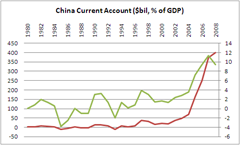
Now take a look from the China side.
image

In contrast to the United States, China is running a surging current account surplus, currently at $400 billion, or 10% of GDP.

What’s Driving China’s Trade Surplus?

image

The above chart may give you some clue. If you organize China’s foreign trade by type, you can see that the regular trade is almost balanced; there’s a deficit in other trade (I don’t know what that is); the processing trade (i.e., importing raw materials or components, assembling, then re-exporting the finished products) is shooting up through the roof.

image

Another way to look at the trade data is by type of corporations. The above shows the February's import/export data of state owned, foreign owned enterprises: 60% of export is by foreign owned. (BTW, the yoy trade volume dropped over 20%.)

So here’s the story: foreign companies have established manufacturing facilities in China for processing goods and re-export. If you are like me, you would be wondering why….

Should RMB Appreciate?

Some guy accused China for manipulate currency and urge China to appreciate RMB. Is it justified?

image

The above is the historical exchange rate of RMB/USD. It used to be that RMB 2 was worth $1. (Really?) In recent years RMB’s been gradually appreciated.

Like many Asian countries, the Chinese authority pegs the RMB to USD, meaning the government decides and maintains the exchange rate. The other kind of exchange regime is float exchange rate, in which it’s decided by the market.

So is China cheating by setting the exchange rate too low (so that Chinese goods are cheaper and thus more competitive)? It is a rather complicated value judgment, but I will tell you what I think.

First it’s about the price level discrepancy among countries. There are measures comparing price levels among countries, and the major one is Purchase Power Parity (PPP).

image

The above is an international comparison of PPP-based GDP per capita and price levels (hint: find Iceland, the allegedly recently bankrupted country). The rule of thumb is that the higher PPP-based GDP per capita (consider it a measure of productivity) leads to higher price levels. In other words, low-income countries set the exchange rate low. And I don’t think all the low-income countries are running a trade surplus. The point is that by such a rule only (don’t ask me who sets the rules on what ground), trade surplus seems not the reason to justify currency appreciation.

Secondly, as I mentioned earlier the export driver of China is really the processing trade by foreign owned companies. Think a minute about how these companies operate. They import materials in USD, pay wages and expenses in RMB, export finished goods in USD for a profit (after wage and tax) also in USD.

If RMB appreciates, they have to pay a higher wage so that the cost would be higher. Although the reality is more complex, if there is another equivalent country with the same investment environment but lower cost level, they may plan to move. Would RMB then be depreciated again?

Thirdly, some evidence from Japan.

image

Japan depreciated Yen by half in the 80s to around 100:1 to USD and kept it there, but it’s been continuously running a trade surplus and current account surplus ever since. Price level induced by exchange rate may not be the only reason of trade imbalance.

Is It Good for China?

First of all, everybody says that free trade is good yet trade negotiation always fail. We live in a bizarre world.

In the case of China, consider the foreign owned enterprises and the resulting trade surplus a stimulus package. It creates jobs and boost local economy (the multiplier). As for the MNCs, they use China as a lower cost production center and selling goods at the same price at home. Consumers also benefit from low inflation. It seems a good deal for everybody.

There’s one problem though. The entire process creates total money supply around the world. It’s well depicted by Wu, the former chief of Foreign Exchange Management Agency. It’s a kind of asymmetric process, and I’ve raised the issue.

Is the Money Safe?

Is it safe to hold so much dollars? The Premier expressed his worry recently.

Fundamentally different from Russia or Mexico that defaulted on their sovereign debt (USD denominated), the United States would not – they can simply print money instead. Under such a guideline, I sold a bunch of CDS on the US treasury and booked a huge loss recently. How could it be?

Besides, the US GDP is 25% of the world (the EU another quarter). If that guy cannot pay his mortgage, what would be happening?

I guess the Premier is worried about inflation and with good reasons. Would there be inflation? I don’t really know. But I guess the time when we see inflation, It would probably be the time when we are out of the recession (though history says otherwise).

What Should China Do With the Money?

The Chinese government has been responsible with the foreign reserve assets. Still, it is a problem, ironically caused by having too much money – image you are a mutual fund manager just raised $2 trillion.

Currently the Chinese government holds most of the reserve in US treasury bills. Probably in an effort to diversify, China Investment Corp, a $200 billion, CDO-type sovereign wealth fund was created. Disappointingly, nobody knows what those guys are doing with the money (ponder this: whose money is it really?).

There is, however, another way to go: encourage the Chinese corporations to invest abroad.

(too tired, to be continued)

http://icecurtain.blogspot.com/

Thursday, March 12, 2009

When Gaming Becomes Culture

You may or may not have never seen this.

image

It’s from the ‘08 annual report of Sohu.com. The number is simply crazy.

Remember when the dot com boom crashed, the big three Chinese Internet portal (Sina, Sohu, Netease) almost got delisted from Nasdaq?

image

You may also like to take a look at Netease [PDF], or Shanda [PDF].

It produced fat-cat CEOs – sometimes really wild, and world-class. Grandpa Deng once said “let somebody get rich first.” His vision has been well realized, but I guess he himself would be surprised seeing what’s happening.

Maybe we should find kids better things to do.

http://icecurtain.blogspot.com/

Wednesday, March 11, 2009

Shenhua: SOBs, Corporate Governance and Market Economy

This post is on China Shenhua (01088.HK), an energy company and one of the FT/Xinhua 25 index. It’s more about things to consider in investing in Chinese state owned businesses (SOBs) than a stock recommendation.

Introduction

It operates coal mines, power plants, railroads and ports. It mines coals in central China, transports them via own railroads or national railroads to market for sales, or to power plants (most in eastern China) for power generation.

Here’s a list of assets owned.

It’s a really really profitable business. Its 2007 revenue was RMB82 bn (including coal segment RMB56 bn, power segment RMB 24 bn), 50% growth from 2006. Net profit was RMB24 bn. See income statement below.

image

Ownership

This is the interesting part. The listed company was part of the Shenhua Group, which is a coal energy mammoth with dozens of subsidiaries. Below is part of the org chart.

image

The group owns 74% of the list company.

image

The group itself, with RMB411 bn in asset and RMB 141 bn in revenue in 2008, is one of the most profitable state owned business.

Implications

Here’s an excerpt from the 2007 annual:

“The Company’s standard of corporate governance has been recognized in the capital market and the Company has won various awards such as the award of “2006 Best Corporate Governance in Asia” («Finance Asia»).”

To me it’s an oxymoron. For an individual investor, if it’s owned 3/4 by the parent company which is in turn owned by the Chinese government, why is corporate governance even relevant? All you can do is to trust that the parent company (hence the government) will keep it profitable. The good news is such company would rarely bankrupt.

Several implications of the story:

  • Market economy

the market economy is this case would hardly work. Suppose you are one of the Shenhua managers (BTW, most of them held government positions) trying to maximize profit for shareholders, you won’t know what to do when the group tells you to pay above-market price for coal purchase, or hold longer for receivables, etc. They won’t do that being responsible, but it’s hard to know.

Or the governments says that you should sell coals to steel plants or power plants for less to help them overcome the economic downturn, since they are also owned by government. It’s socialism at its best.

  • Stock market

this also illustrate why some guys advocate government supporting the stock market (though the premise is absolutely false). The Chinese stock market is government-driven, because the government has a lot in it. For stock pickers, it takes a quite different skill set.

  • Environment issue

China is short of oil and natural gas but coal abundant and uses a lot of coals for power generation. The immediate issue is carbon emission and global warming, which is also a petroleum problem.

In a market economy, the government would have to adjust the incentives for the economics of the clean energy to work. For example, I seriously think the U.S. should hike the gas consumption tax, like Demark, besides the cap & trade.

The Chinese government, with its immense and somewhat skewed market power, can take a different approach. It’s a much simpler process in China to allocate land for wind and solar sites (the government, hence the people, owns the land collectively), maybe also biomass for incremental power generation. I didn’t do the math, but it would be worth it even with some heavy subsidies to begin such a national industry of tomorrow.


P.S. for investment decisions, look here.

http://icecurtain.blogspot.com/

Saturday, December 27, 2008

Hedge Fund in China

I was buying insurance online the other day, and I found a hedge fund in serendipity, buried in my insurance company (or shall I say financial conglomerate). Look at this and this.

Some specifics on 平安财富鹏远核心一期集合资金信托计划

Hedge Fund? First of all, it is a hedge fund, though they deny it. Hedge funds are well known by the 2/20 (i.e., 1~2% administration fee plus 20% of benchmarked return). This fund charges: 1.5% admin fee, 20% of return, 0.25% keeping fee (?), 1% front load, 5% before-schedule redemption fee. Hedge funds court wealth individual et la, this fund set an entry level of RMB 3 million, so not for little people like me. Is it a hedge fund or not? Why play coy?

Who Handles the Money? If it’s not a hedge fund, it’s a FoF. Notice the listed investment consultant, 鹏远(北京)管理咨询有限公司. I guess it’s very possibly those guys who manage the money, via the hat of the “largest hedgie company,” and they profit-share in some way. I don’t see any reason why they’re here otherwise.

Expected Return. Noticed the return they promised (but not guaranteed)? Expected return 6.5%~10.5%, no upward limits, by investing in share-collateralized financing projects. Umm, I wonder how they can achieve it. Before fees, the required gross return would be 10%~15%, while the PBoC benchmark loan rate is 5.4%. If they leverage up, they’re more a hedge fund.

Investors. They’re open to both individual and institutional investors. The institutional part usually consists pension fund, college endorsement, etc. I wonder who are those ones in China.

Wednesday, December 24, 2008

“Nobody’s Worth That Much”

This is wild: 唐骏年薪为何十亿.

Although the number is a bit of a widespread hyperbole (thanks to the over-enthused hearsay reporters), it’s still really, really wild.

If I may describe the new employer 新华都, the appropriate word would be .. silly. I guess they carried out the event more as a PR campaign than hiring a star manager, only I don’t see how they’d cash in the built awareness. The read here is that they do funny things and they don’t care about spending. Remember the name and don’t be a shareholder.

I talked to my compensation consultant on this. The reply is, first of all, “I thought China is a communism country, am I wrong?” Second, the price tag would get almost anybody, if price is the only consideration, so he hopes the hired is really that good.

He has an additional thought: if he’s to advise that 新华都, he’d have them retag the price to RMB 888 million (instead of the stated RMB 1 billion, whatever is in it) - the new luckier number would do absolutely the same in all aspects. As for the RMB 112 million saved, he’d bill them half of it for the advice. A better deal for everyone, isn’t it?

P.S., A CEO compensation benchmark:

image

http://icecurtain.blogspot.com/

Tuesday, December 9, 2008

What's NOEs' Worth

Inspired by Prof. Lang, here’s some stats from the State-owned Assets Supervision and Administration Commission, collectively owned by the good people of China:

“2006年,全国国有企业户数共计11.9万户,比2003年减少3.1万户,年均减少8%。但累计实现销售收入16.2万亿元,比2003年增长50.9%,年均增长14.7%;实现利润1.2万亿元,比2003年增长147.3%,年均增长35.2%;上缴税金1.4万亿元,比2003年增长72%,年均增长19.8%;企业资产总额29万亿元,比2003年增长45.7%,年均增长13.4%;户均资产2.4亿元,比2003年增长84.6%,年均增长22.7%。”

Here’s a simple valuation:

Net Income of all NOE is RMB 1.2 trillion, Market Value =

  • RMB 6 trillion @5x P/E
  • RMB 12 trillion @10x P/E
  • RMB 18 trillion @15x P/E
  • RMB 24 trillion @20x P/E

It’s roughly the total market value of listed on Shanghai Stock Exchange or Hong Kong Stock Exchange, or the worth of Mongolia, or any of a list of African countries.

Sunday, December 7, 2008

Our Money OK!

I always think that mutual fund is a good business, not necessarily for investors, but surely for asset managers. Imagine you manage a fund of RMB 100 million for 1% fee, you make a million for sure, no matter how the fund does (though it matters a lot). In a sense, hedge fund is part of the asset management business, except it serves a special group of people on a different incentive plan and under different regulatory requirement.

The money pools can sometimes grow really big – here’s a list [PDF]. I learned that when a fund reaches the billion range, higher-than-normal returns become increasingly challenging, that’s why I found the ‘07 result of the Social Security Fund (SSF) jaw-dropping.

“本报告期末,按成本计算,基金资产总额4396.94亿元,其中:社保基金会直接投资资产2327.54亿元,占比52.94%;委托投资资产2069.40亿元,占比47.06%。按市值计算,基金资产总额5161.52亿元。

[..]本报告期基金已实现收益1129.20亿元,已实现收益率38.93%;本报告期浮动盈利增加额324.30亿元,经营业绩1453.50亿元,以此计算的经营收益率为43.19%。”

What? 43.19% on a multi-billion fund, and 38.93% realized? Given that the stock market shot the light off last year, it’s still a surprise.

Digging further, I found this in the Investment Guidelines.

“第二十八条 划入社保基金的货币资产的投资,按成本计算,应符合下列规定:(一) 银行存款和国债投资的比例不得低于50%。其中,银行存款的比例不得低于10%。在一家银行的存款不得高于社保基金银行存款总额的50%。(二) 企业债、金融债投资的比例不得高于10%。(三) 证券投资基金、股票投资的比例不得高于40%。”

And this is what the fund manager did when the stock market skyrocketed:

“近几年来,社保基金理事会按照社保基金资产配置计划的要求,对股票投资进行了双向的纪律性再平衡操作。从2003年至2005年,社保基金股票占总资产的比例,低于资产配置计划的目标比例,社保基金面临股票投资不足的风险,不利于社保基金长期保值增值。因此,社保基金逐渐增加了股票投资比例。2007年,由于股票市场大幅上涨,社保基金股票投资比例,在进入目标比例区间后一度超过目标比例,较大偏离了资产配置的比例区间,使社保基金整体风险超出资产配置计划要求的风险承受水平,需要通过再平衡操作来降低股票投资比例。因此社保基金进行了纪律性再平衡操作,使股票投资比例回到了资产配置目标区间。”

Thanks to the discipline, my pension safe! Yeah!

Can’t wait to see this year’s balance.

Saturday, December 6, 2008

$1 Trillion for Christmas Shopping

You are in suit business. Usually you sell a suit for RMB 1,000 on a cost of RMB 800, so business is good.

One day an importer from Iceland called you for an order of 100 suits, paying ISK 70,000 (Iceland Kroner) per suit, delivery at 6 months later.

You checked the exchange rate: the price equals RMB 1,200 (ISK 10 = RMB 1), enough to compensate delivery and other extra costs. Besides, you're excited to open a new business line in Europe. So you decide to go ahead.

...Upon delivery, ISK depreciated to ISK 20 per RMB 1.

International business brings an additional risk, the currency risk. Unscrupulousness will blow things up, sometimes costly.

That's why I can never understand why there's the Forex trading business for individual investors. I can't see any legitimate purpose beyond pure speculation. And it's leveraged.

China's $1 trillion

This explains why it bogs my mind when looking at China's USD 1 trillion reserve.

It's accumulated over the years when China was running a large and rising trade surplus with the US. The 2007 Current Account (I don't know what it is) stood at around $300 billion, or 7% of China GDP.

The nature and the sheer number makes it a bit larger and more complicated issue than the suit business. It seems both side consider the imbalance more a prob.

Prof. Wu spoke about it recently from the China side (吴敬琏:解决内外失衡的出路在于推进改革,实现增长模式的根本转变). You cannot find a more educating explanation. Warren Buffett also expressed his concern on it.

However, more questions remain. For example, when RMB appreciated 10%, does it mean that the reserve has lost $100 billion in value? Now China is pegging RMB to the dollar, how should China manage the Forex policy in the future?

Most importantly,

How should China spend the Money?

Right now, China is holding a huge amount of US treasury notes, using the US as a bank while trying to figure out how to spend the lump sum.

Chinese economic development has in a sense taken a route of Japan (and I have to say that it's not necessarily a good sign). It may help to take a look at Japan.

Japan was running trade deficits and accumulating foreign reserves. Besides holds a big sum of US treasury notes, it's been in a shopping spree around the world. Overall, it holds $3 trillion in financial assets around the globe, plus a FDI position of an additional $1 trillion. It bought the Rockefeller Center and Columbia Pictures.

Can China do that some day? Will China do that?

Thursday, December 4, 2008

Stimulate the Domestic Demand

The amazing growth rate of the Chinese economy has partly driven by the export growth of the manufacturing sector. "China is the world factory," as they say. It's done by maintaining a certain level of price discrepancy by a currency peg to the USD, attracting FDI while supplying abundant labor force to the world.

Now the export (around 35% of GDP in '07) is deteriorating responding to the global recession, how to stimulate the domestic demand becomes more important.

It's actually an old topic that's been talked about for years. Chinese economy saves almost 50% of GDP, hence the high investment rate. In comparison, the U.S. saving is 20%. As for the household sector, the Chinese saving rate is 50%, while that of the U.S. is virtually zero.

I have some random thoughts on the disparity of the consumer saving/spending rate between China and the U.S.:

First, there's a cultural thing. US consumers have a passion on shopping for some reason. read Born to Spend, I shop therefore I am for an understanding.

To support it, US has a well developed consumer credit market: the total consumer credit outstanding stands up to $2.6 trillion. It's not only mortgages, but HELOC, car loans, credit card, etc. it allows you to pay installments even for furniture.

Besides, US has a consumer credit system to back it up. Every citizen has a credit score, a historical score keeper for your past credit borrowing and repayment as well as a gorge for creditors' lending decisions.

A sound social safety net (pension, healthcare, unemployment insurance) is also significant. Although the US doesn't carry too much pride in this area - the Viking countries are role models - it should be well developed.

Income inequality counts. I'm not against Grandpa Deng's "Let some get rich first" policy, but some part of Chinese population is really, really poor. If someone brags to you the market size of cell phones in China, saying "if everyone buys a phone, it's a 1.3 billion market." he's bullshitting.

Finally, there's the long-term economic and social stability.

What's not on the list is a booming stock market. If you're a frequent reader of this blog, you know that I have some beef with "十教授上书建议扩大内需把提振股市作为切入点." The last post is here.

Those lame ducks spoke again today:

"是不是能够使用资本市场的提振措施来刺激国内的需求,从1998年的时候刺激房地产,刺激股市,的确对后来的内需起到了很大拉动作用,这在十年前是有成功经验的。10年前已经有过成功经验的情况之下,推出这样一个以刺激股市为内容之一的内需提振政策,我想应该是有点效果的。"

"根据美国经济学家的测算,就是行情好的时候,财富 效应对消费需求具有一个固定的带动系数,比方说,股票涨了100元,肯定其中要有7元或8元钱,拿来去消费。这是一种非常巨大的消费需求支出比例。"

I've never heard of US federal government interfering stock markets. In fact, they hate doing it.

What are you suggesting, professors? A government-led Ponzi Scheme?

I want my digital TV.